Women in VFX | Bhavika Bajpai
Meet the women who are inspiring the future of our industry!
Meet the women who are inspiring the future of our industry!
Inspired by the Visual Effects Society's global 'Women Who Lead' initiative, our Women in VFX series puts the spotlight on our female superheroes across our global teams, exploring the different paths they’ve taken, the challenges they’ve navigated and the experiences that have influenced their careers.
Scroll to meet Bhavika Bajpai, CG Build Supervisor / Creature!
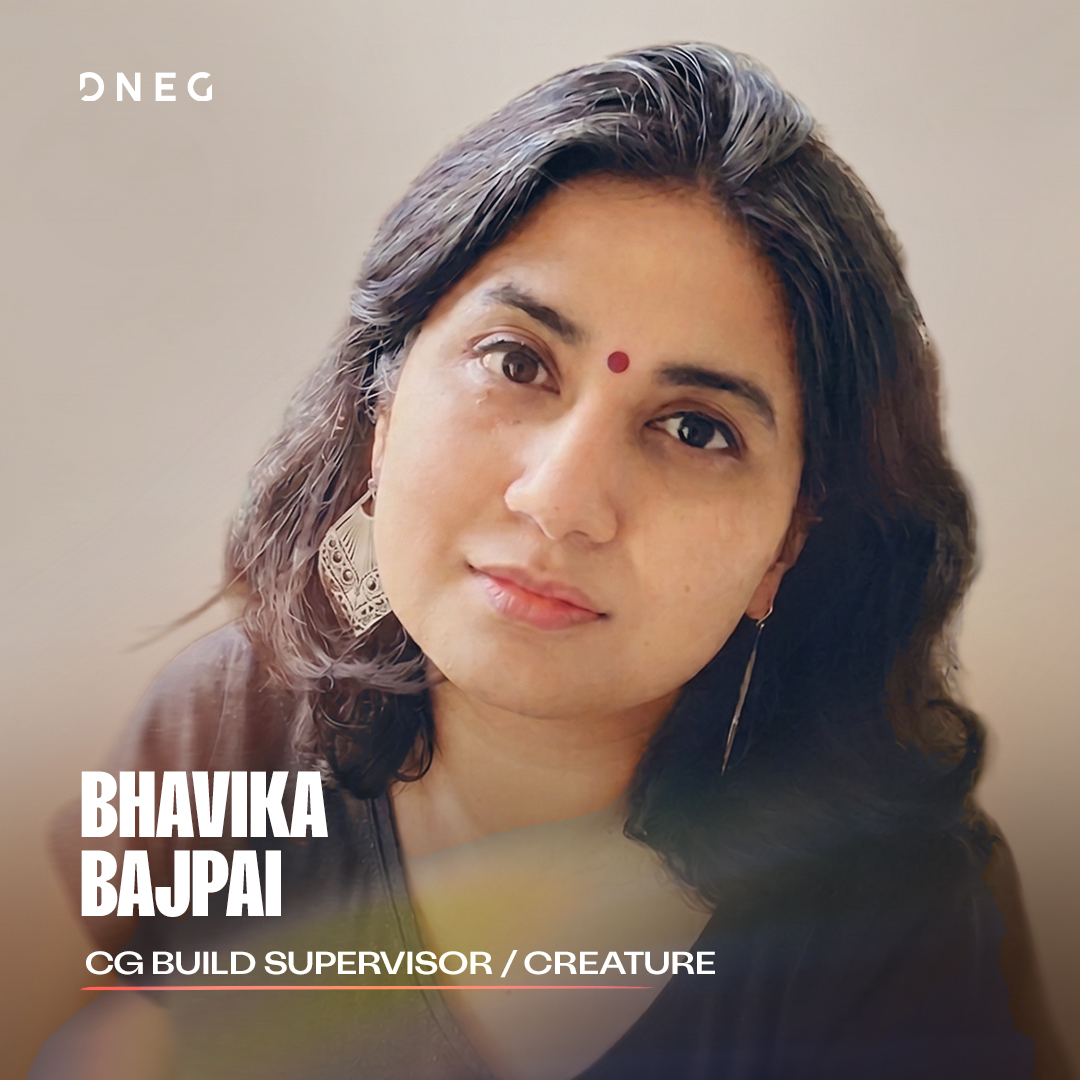
Please briefly introduce yourself and share something unique about yourself that you’d like our readers to know about you.
Hello, My name is Bhavika Bajpai and I have been doing VFX for about 22 years now. I started out as a LookDev Artist but gradually moved to Fur Grooming and finally to Asset Supervision.
What originally sparked your interest in VFX, and when did you realize you wanted to pursue it professionally?
My first memory of being completely blown away by VFX was when I watched Jurassic Park as a little girl. I just could not believe that something so life-like could be created purely from your imagination to appear on the movie screen. At the time I didn’t think of doing it professionally, but as I grew up, I wanted to do something that blended art and technology, so VFX was perfect for me. At the time, the field was very new, especially in India where I grew up. But my mind was made up and after I finished my Engineering Undergraduate Degree, I did a Masters in Computer Animation at Bournemouth University.
Can you pick out a key milestone or event that shaped your career path?
When a film I worked on, Life of Pi, won the Oscar for ‘Best Visual Effects’. I had worked on a few films before that and it was always amazing to see my name at the end credits, but after that Oscar win, I felt like I was part of something special. The whole world was celebrating my work.
What are the core technical skills that have been essential in your role?
The core technical skills that have been useful for me have been knowing my way around Maya and Houdini. As an Asset Supervisor I need to know a bit of everything, but more importantly, I need to spot issues or inconsistencies in the technical side of building an asset as early as possible in the build.
How has your technical skillset evolved as you progressed in your career?
Initially, I started out as a Shading Artist and so I was focused more on the shader and renderer side of the pipeline. Later, I transitioned into Fur Grooming, so it became more about learning how to replicate the intricacies of hairstyles and creature grooms.
What challenges (or mistakes) in your career have taught you the most, and how did you navigate them?
The biggest challenge has been to constantly keep learning while at the same time delivering high quality assets. Sometimes, I have felt really frustrated by not having enough time to keep up with the changing pipelines and softwares. In those moments, I have reached out to colleagues and mentors. Their advice has always been to focus on the task at hand, to do the best I can and let things flow. There is always room for improvement, but it should not stop us from doing what is right in front of us.
What has been a defining moment that significantly changed your perspective or career direction?
The moment I started doing Supervision, my perspective for the work totally changed. I was no longer only looking at one asset for one discipline. It was about looking at the whole show. This shifted my focus to workflows, problem solving and the flow of assets through the whole pipeline process.
What are the key (and even “secret”) ingredients to creating extremely believable and emotionally engaging creatures?
For me, the key is always to have some real world reference to support every part of the build. We interact with the real world constantly from birth and our eyes are trained to spot what feels unnatural pretty quickly. In addition to that, there is a very sensitive balance between too little detail and too much detail. Both end up looking fake. This is something we train ourselves to look out for as Asset Supervisors and hopefully guide the artists towards believable yet engaging creatures.
How do you collaborate across departments (e.g. rigging, animation, FX) to bring creatures to life?
Ultimately, all the departments want exactly the same thing. We want to deliver a creature that is believable and efficient to work with in the pipeline. We have constant collaborative discussions with facial, rigging and CFX early on in the build process. This is because we are not building a statue; we are building a creature which will move and emote. If there are suggestions or concerns from these disciplines, we factor those in early on and continue to pass assets back and forth in the pipeline to make sure it will work for its purpose.
What is your favourite project you have worked on and why?
My favorite project I worked on was The Lion King (2019). I grew up watching the animated version as a child, so having the privilege to work on the live action adaptation was amazing.
If you could go back in time, what advice would you give your younger self?
Have more faith in your work and your abilities. Speak your mind.
What kind of mindset helps women succeed or stand out in VFX technical roles?
Treat yourself as an equal to your male counterparts and everyone else will do the same. Be kind yet firm.
Thank you, Bhavika!