Women in VFX | Bamboo Wang
Meet the women who are inspiring the future of our industry!
Meet the women who are inspiring the future of our industry!
Inspired by the Visual Effects Society's global 'Women Who Lead' initiative, our Women in VFX series puts the spotlight on our female superheroes across our global teams, exploring the different paths they’ve taken, the challenges they’ve navigated and the experiences that have influenced their careers.
Scroll to meet Bamboo Wang, FX Supervisor, DNEG Animation!
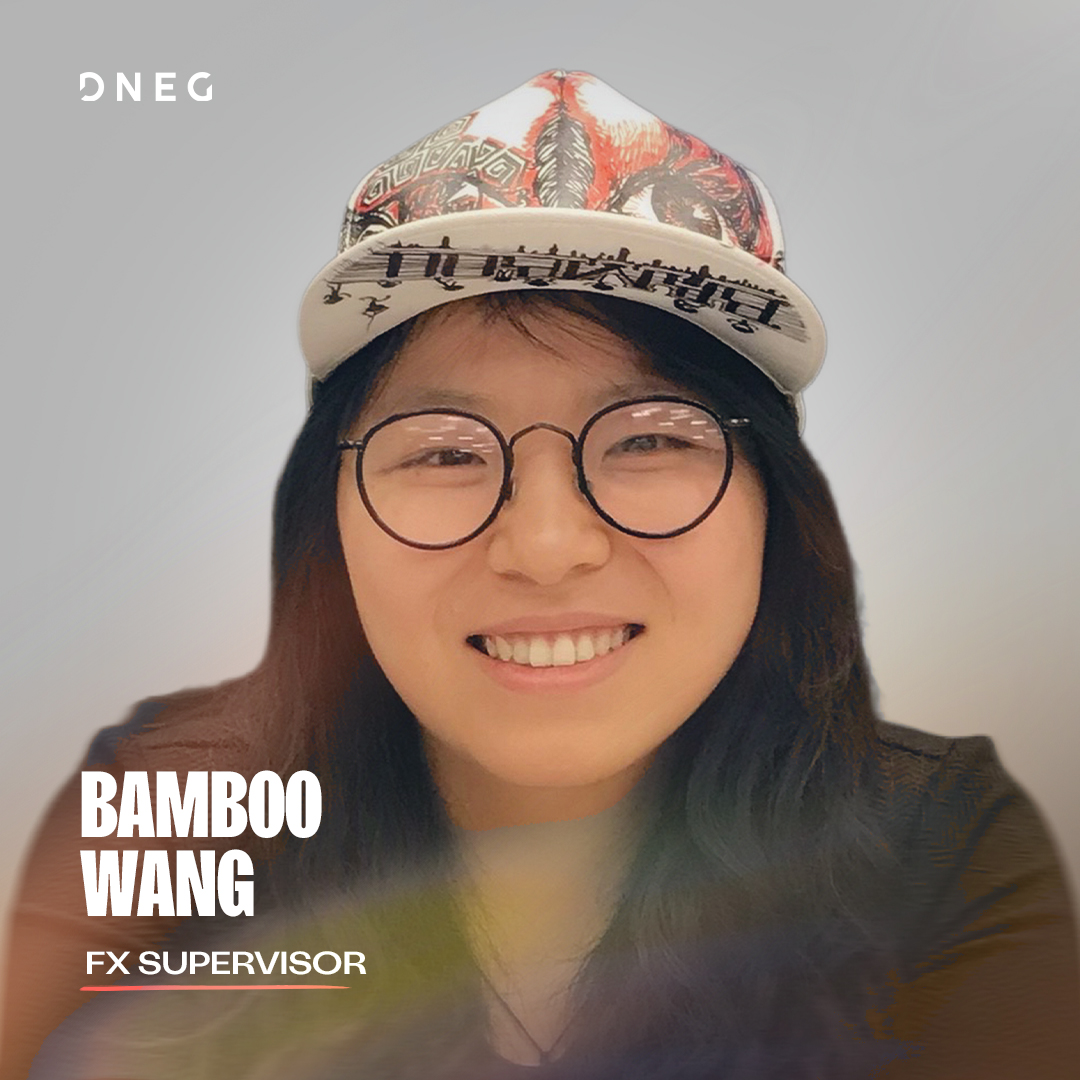
Please briefly introduce yourself and share something unique about yourself that you’d like our readers to know about you.
Hi, I’m Bamboo! I’m an FX Supervisor at DNEG Animation. I’m from China, did my graduate study in San Francisco, and came to Montréal to start my FX career in 2015. Before moving into the animation field, I was working in VFX as an FX Artist. I love animation! I also like illustration and cooking.
What originally sparked your interest in VFX, and when did you realize you wanted to pursue it professionally?
I started this journey from being a hardcore manga fan. At 10 years old, I started to draw all over my math, history, and literature text books and got into so much trouble in school because I didn’t want to study anything. All I wanted to do was read, watch, and draw anime! Until one day, my mom sat me down and asked me: do you want to become an artist? After that, I got into an art-focused high school, majored in animation in college, learned FX in grad school, and then became an FX Artist, an FX Lead, and now an FX Supervisor.
Can you pick out a key milestone or event that shaped your career path?
There’s a few milestones; it’s hard to choose just one! But if I have to, I would go with when I was promoted to be an FX Lead. The first day after my maternity leave, I received my promotion letter to become FX Lead on Nimona. It was a challenging project but it was also really rewarding. I got through the crunch time while breastfeeding. I remember when I was a kid, my mom told me she had to give up career growth and a few better opportunities after she had me. The women in my family before me either had to give up their career opportunities or never had a career to begin with in order to raise a family. I’m glad to live in a time and place that allows me to reach my full potential without having to choose or compromise!
What are the core technical skills that have been essential in your role?
For the FX department the essential is definitely Houdini skills.
How has your technical skillset evolved as you progressed in your career?
When I was in school I didn’t really care about doing FX or lighting or animation…I mainly got interested in learning Houdini. Back then we didn’t have a Houdini course or tutor, so I organized a Houdini workshop for FX students. After that, I have been learning and evolving with the job. Whenever there’s a new challenge, it means a new opportunity to learn. After I joined DNEG Animation, especially after going into leadership positions, I started to pick up more cross department and pipeline related knowledge. I found the best way for me to learn is through practice. I strive on troubleshooting, so whenever I find a block I look for solutions, and my skill just evolves during the process!
What challenges (or mistakes) in your career have taught you the most, and how did you navigate them?
We all make mistakes, and learn from them. I am an ambitious person and I have a lot of ideas, however I’ve always struggled with editing down my ideas so I could complete them within a time frame. One time, when I was still a Junior Artist, I asked for a more challenging task and my lead gave me a waterfall setup to do. There was so much I wanted to achieve with this task, but it was out of my scope. In the end, I couldn’t finish the setup in time, and the Supervisor had to go with a different creative solution - taking the waterfall out of the environment altogether! I felt really bad, like I failed the task. Now, looking back, I know I should have communicated my limits earlier on, and I should have had a more realistic goal instead of trying to prove myself past my level of experience at the time. It took me a while, but I learned that instead of always trying to overachieve, I should leave some room to breathe. No one can always exceed the limit; long term it will most definitely result in either a crash or burnout. When I joined DNEG Animation, my first supervisor told me if I have 6 hours of productive work inside of an 8 hour work day, it means he assigned the right amount of work. The extra 2 hours can be some last minute changes, or just some time to relax and breathe. Now that I’m a supervisor, I always keep what he said in mind. Before I commit to a deadline, I take a minute to step back and ask myself: Did I leave enough room for my team and me to relax and breathe? I am still navigating this, and I think trying to be mindful about my limits and boundaries will be a consistent topic throughout my career. Not just for myself, but for my team, too!
What has been a defining moment that significantly changed your perspective or career direction?
In 2017, I was working as a Jr FX TD. Later on, I realized I was actually a bit depressed back then, but at that moment I was too focused and burnt out to realize anything wrong in my life. I was working a lot, and getting short term extensions every few weeks, worrying about where my job would be every 2 weeks. At one point I had to ask for a half-day off to do laundry; I was worried that once I took any break or stopped working, they’d take my job away and not extend my contract anymore! My work permit had expired already, and I was told that the company applied for the extension. I just needed to wait. Until one day, I got pulled into an office, and was told there had been an immigration error. The lawyer made a mistake, something I had zero ownership of, but had 100% impact on me - turned out, I was working out of status for the last 6 months and needed to leave my post, and Canada, immediately! I had arrived in Canada with no friends or family, so everyone I knew and everything I owned was tied to my career, and it was just taken out like that. For something completely out of my control! I remember that day I walked out of the building, it was cold and raining, I thought I lost my path and future. I felt confused and powerless.
Turns out that was my lowest point, and every day after that was going forward and upwards. I thought I lost everything, but my skills, my experience, and my passion is not linked to a company or a position. My knowledge and courage have always been my best assets, not a job title. If it hadn't been for that unfortunate immigration error, I don’t think I would have had the opportunity to step away and rediscover myself, instead of getting further lost and consumed by a toxic work environment. Only after I left did I realize that the whole world was my stage; I had been gaslit and couldn't see what was beyond! I did leave Canada in 2017, but I got another offer from a different company in Montréal a year later. I came back and stayed, but this time I knew to build my boundaries, work my reputation up, and voice out my opinions. I always remember: I’ve had worse, and I survived!
How do you balance creative vision with technical and production constraints on a project?
I think my 2D background really helps me with the creative vision. Usually when I get a brief, or feedback, I can always envision it in my head. If I can’t, I make sure to communicate until I can! I found something interesting - at Disney Animation, they call their FX Artists “FX Animators”, in a way I think that’s more accurate in the feature animation division. I quite often tell the artist to make an “FX blocking” pass and get the timing and performance locked, instead of getting into the details of the physically correct simulation. I found borrowing the “blocking” concept from animation really helps to get the creative direction sealed early on, so we can be more efficient with less feedback loop. I also often tell the artists to manage the variable, so we know we can get consistent outcomes between iterations.
What is your approach to mentoring and guiding FX artists with varying levels of experience?
My main approach is to drive with motivation and trust. As long as I make sure the expectation is explained thoroughly, I don’t interfere much with the creative process unless the artist expresses needs. FX Artists are a group of the most genuine and passionate people in my opinion. They usually push themselves to reach the maximum outcome and their creativity often surprises me. I usually start to know someone in the team by asking about their favourite type of FX, what they want to do and what they want to avoid doing. Once I learned their expectations, I try my best to accommodate them within my resources. I found usually putting the right people on the right task, everything just clicks from there. Once the artist is inspired, there’s very little guidance needed and the creativity shows in the result.
Can you give an example of solving a particularly complex FX challenge?
The shadow monster in Nimona was a fully FX-created character! It appeared in nearly 100 shots—including over 20 hero shots—across three key sequences. The FX presented challenges on multiple fronts: first, we needed a highly procedural setup to handle the high shot volume; second, it had to meet strict performance requirements, meaning the rig had to be extremely art-directable. As the emotional core of the film, this creature played a pivotal role.
Automation and artistic accuracy are usually at opposite ends of the spectrum, but we had to push both to the absolute limit for this effect. Supported by great supervisors who set the strategic vision and an exceptionally talented team of artists providing creative solutions, I led the FX team to ensure a consistent workflow across three different production sites.
Just three months before our deadline, we received new direction regarding the creature's edge details. The monster was made of shadow, with smoky tendrils constantly generating and dissipating from her body, but the director wanted sharp, precise edges. For instance, a subtle shift in her eyeline could change her emotion from sad to tired, or if she was exhausted, small crumbling particles needed to break off as she walked. One of our senior artists developed a system that gave us control over where the shadow edges should have that "lost and found" quality. I then integrated this setup into the main rig and rolled it out to the team.
Through this experience, I learned that a vital key to FX in feature animation is striking the right balance between artistic control, procedural generation, and automation.
What is your favourite project you have worked on and why?
There is an upcoming release that I really enjoyed working on. I love the IP, and found I was really good with understanding the client’s request. There’s a very specific design for the style of the universe, but the director wanted to push it up a level while keeping the FX physically believable. I really enjoyed the challenge, and I had a great team to work with. We had seniors with over 20 years of experience and juniors fresh out of college, but we all worked well together and the communication was seamless! My VFX Supervisor used to be my FX HoD, so I had a trusted, easy communication between my team, my supervisor, and with the client. I can’t wait for the project to be released so everyone can see our work and feel the pride I’m feeling now!
If you could go back in time, what advice would you give your younger self?
I want my younger self to not be so hard on herself. I would tell her to be more proud and have more confidence!
What kind of mindset helps women succeed or stand out in Animation technical roles?
I struggle with confidence. If you find yourself struggling with the same, what I taught myself is: instead of trying to “be more confident”, I just tell myself “be brave enough to [BLANK]”. For example, “Be brave enough to speak up” or “Be brave enough to make this request”, etc. I feel that “confidence” needs proof of capacity up front, and I struggle to find the proof of my capabilities (even though I shouldn’t). But the thought of "bravery" doesn’t require me to be good enough, and it was somehow more acceptable for me to start practice, and once I get enough practice out of courage, confidence starts to generate from there.
What skills turned out to be more important day-to-day than you expected?
Time management: As artists, we know how to value and improve both our creative and technical skills, but time management is a major asset that is often overlooked.
Thank you, Bamboo!