Women in VFX | Francesca Galluzzi
Meet the women who are inspiring the future of our industry!
Meet the women who are inspiring the future of our industry!
Inspired by the Visual Effects Society's global 'Women Who Lead' initiative, our Women in VFX series puts the spotlight on our female superheroes across our global teams, exploring the different paths they’ve taken, the challenges they’ve navigated and the experiences that have influenced their careers.
Scroll to meet Francesca Galluzzi, Pipeline Supervisor, DNEG Animation!
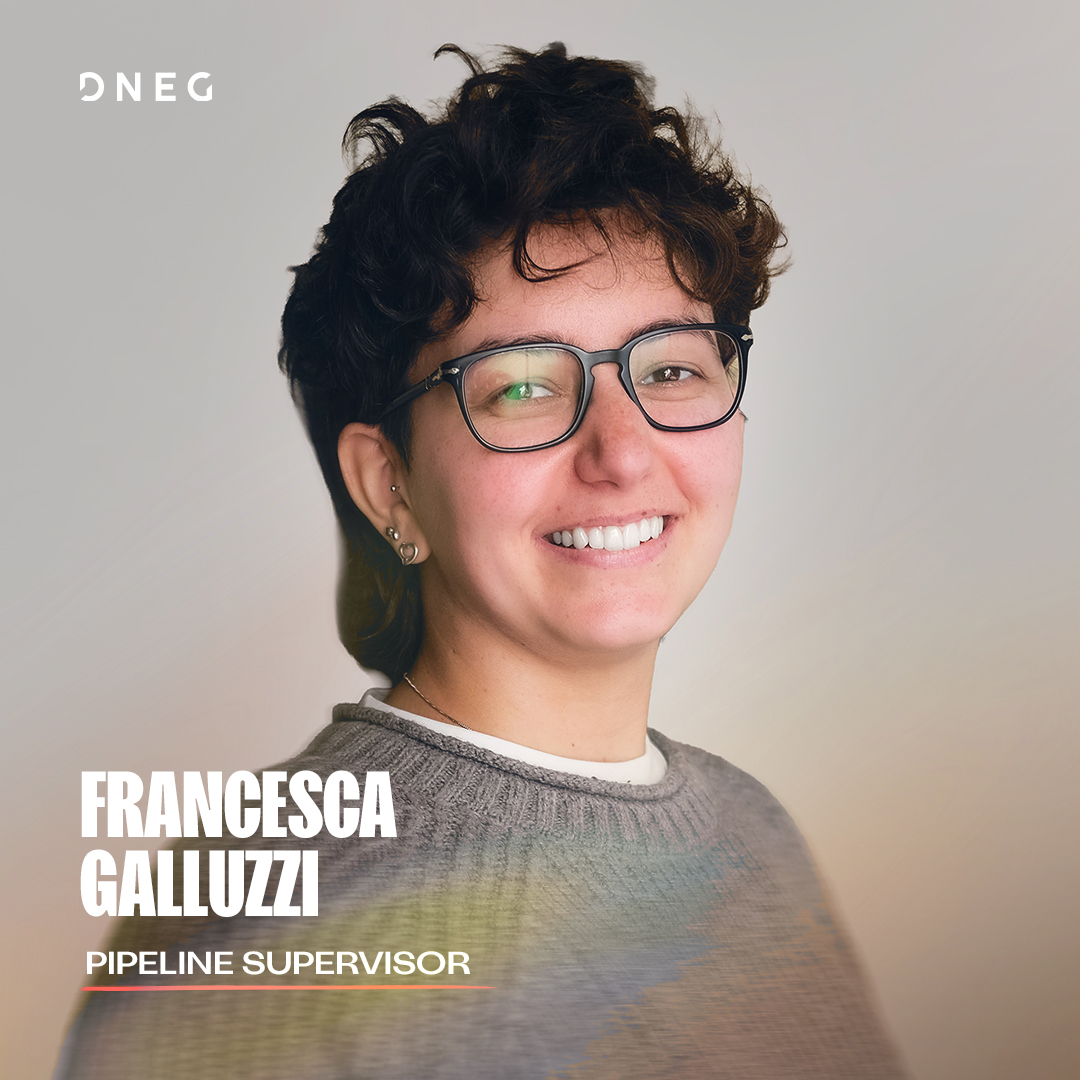
Please briefly introduce yourself and share something unique about yourself that you’d like our readers to know about you.
Hi! My name is Francesca but everyone calls me Fran. I’ve worked at DNEG Animation for the past 8 and ½ years and I’ve been a Pipeline Supervisor for 4 of those years! My dream in life is to become a crazy cat lady. Fun fact: 3 out of 3 of the projects I’ve supervised so far have cats (or cat adjacent) characters as the main part of the story. Coincidence?
What originally sparked your interest in VFX, and when did you realize you wanted to pursue it professionally?
I can’t pinpoint an exact moment in time when I made that decision. Like many millennials, I grew up watching Disney movies and anime reruns on tv and then I slowly realised I didn’t wanna stop at just watching them anymore. Around the end of high school, when you need to become serious about what you want to be when you grow up, I thought to myself, “Animation is done on computers nowadays, right? Well, someone has to be setting those computers up”! Hence began my pursuit of a technology career in animation.
Can you pick out a key milestone or event that shaped your career path?
For me, the main turning point was at the end of my Undergraduate Degree. Up until then, working in Animation was just a fantasy in the back of my mind and I was mostly focused on building up enough foundation for a “plan B”. It was when I finally decided to start focusing on the “plan A” that things started moving forward in the right direction which eventually led me to join DNEG at just 24 years old, something I’m very proud of!
What are the core technical skills that have been essential in your role?
A good solid understanding of Python is the number 1 essential, since 90% of an Animation pipeline is made up of Python. It’s important to be able to write efficient code following the latest standards but also to be able to navigate legacy code, for debugging and maintenance. Right after that, being familiar with principles of software engineering is really useful to be able to design new complex bespoke solutions. And, finally, it’s essential to be familiar with the tools and workflows the artists are using, what are the problematic areas and what are the performant areas, since ultimately our job is to ensure the artists can focus on their craft instead of fighting the technology.
How has your technical skillset evolved as you progressed in your career?
Other than the obvious improvements on my coding skills, what really made me grow in my career was to be able to really see and understand the intricacies of our pipeline and being able to predict where the friction points might appear. The ironic thing about working in Pipeline is that the more senior you become, the more the job is about looking at the bigger picture and the flow of data, rather than the specific lines of code.
What challenges (or mistakes) in your career have taught you the most, and how did you navigate them?
The very first production I supervised (The Garfield Movie) really put to test all my pipeline knowledge to that date. Plus, I had to learn to juggle new managerial-type tasks that came with the Supervisor role, an ever growing list of requests and priorities coming from the production and the requirements at a studio level for growth and improvement. Establishing good time management techniques and organisation of tasks techniques for my needs has been key to be successful in the role.
What has been a defining moment that significantly changed your perspective or career direction?
Unfortunately, in the aftermath of the COVID lockdowns, the entire film industry went through a period of difficulties. It was also a time when I had to decide for myself if I wanted to jump ship or navigate the hard times until we encountered calm waters again. That’s when I had to reconfirm with myself that I do work in Animation out of passion and that this is really my main source of joy in my professional life.
What principles guide your decisions when designing or refactoring a pipeline?
I look at the biggest pain points for artists and what their ideal solution could look like, then look at what the latest technologies in the industry can offer and finally filter it all by how many resources (human or monetary) we have available to achieve the best solution that can fit all these criteria.
How do you balance long-term pipeline development with immediate production needs?
First of all, I try to establish a priority of tasks coming from production, for example by evaluating if the problem could have a workaround or if this is a show stopper. Once the urgent issues are sorted, then the next evaluation to do is gain-over-effort score, meaning establishing if the benefits of addressing a certain request are really worth the investments of resources. Part of this evaluation also includes looking at the long-term plans and avoiding any duplication, for example it may not be worth addressing an immediate need with a well refined solution if there is already a plan for development that will cover that request and more. In those situations, I focus on creating smaller solutions that are just good enough to buy some time until the long term plans are in place.
What's your approach to building a strong relationship between pipeline and production teams?
I found that the best thing to do as soon as I join a production is to reach out to the show leadership and do a few zoom calls with them to effectively just let them know I’m there. From my experience, the more folks in production see you being there in the day to day work, the more they will feel more comfortable reaching out for support. The key is to not be a stranger, but turn myself into the first thing they think of when there is a pipeline struggle.
What is your favourite project you have worked on and why?
Ouch, it is a bit like choosing your favourite child! All projects I worked on have a sentimental value to me because they all represent different milestones in my work life. On a personal level, I feel particularly close to the story of Nimona and I’m very glad I got the opportunity to be a TD on that production.
What kind of mindset helps women succeed or stand out in Animation technical roles?
If you are given an opportunity it is because you deserve it, don't ever think otherwise. I feel like this advice should apply to all roles, actually!
What excites you about the future of Animation?
It’s so great seeing the artists fight for their art and keeping it an expression of human experience and emotions. I’m excited to see how the craft will evolve while remaining true to these values.
Anything else you would like to share with the next generation of women in the industry?
One thing that I myself struggled to understand for a long time and would like the younger generation to know is that we are usually the first ones to believe we are “too limited” to do a certain job. Try to break free of this mental barrier as soon as possible and you’ll see we are all just people, gender doesn’t matter, and we all just happen to have a different set of strengths and weaknesses. This freedom will guide you in your career, even if you encounter environments that are still hostile to this idea.
Thank you, Francesca!